Just use long pieces of steel and forge one end. Keep a bucket of water to cool it off in periodiaclly.
It's really as simple as that...
Also to get started you can use pliers of all sizes and vice grips (which were invented by a blacksmith trying to make better tongs) Longer is better if you can control them...
Obviously if you can get an anvil that's what you want...
but what if you cant' get one yet?
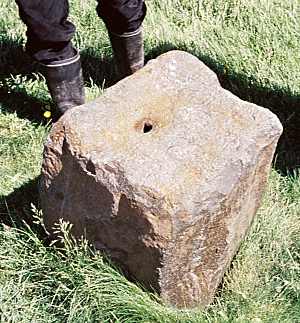
One of the most famous Smiths of the Viking sagas used and anvil that was just a large flat piece of very hard rock.
Lots of primitive peoples do this still
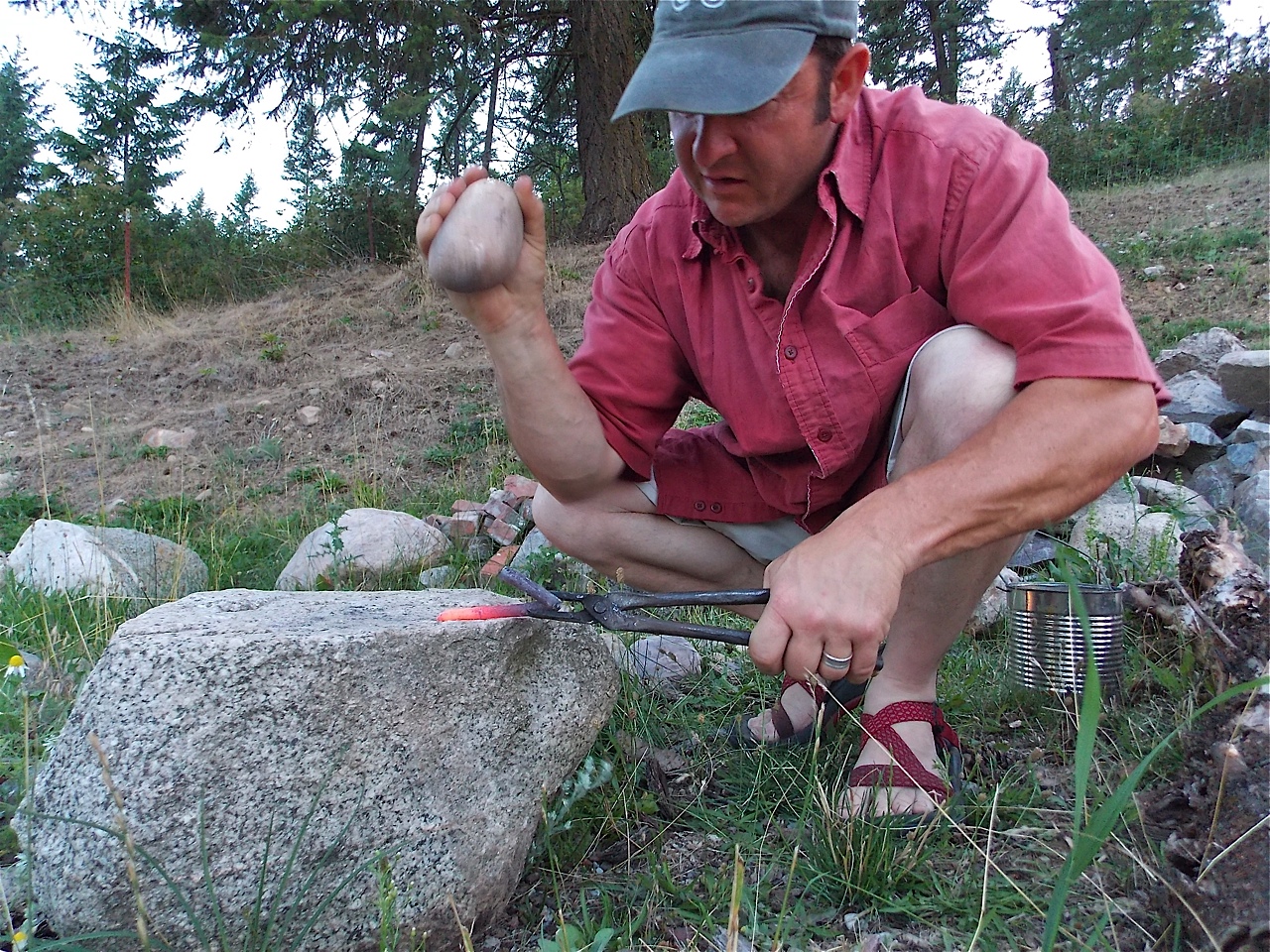
Bigger and heavier is better, the less it wiggles or jumps the more of you force goes into moving the metal... but anything can work.. a rock, a curb, the hitch of a truck...
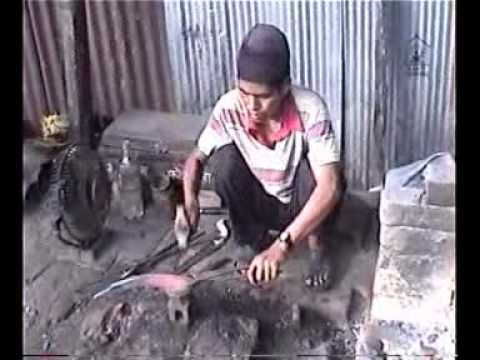
Lots of 3rd world anvils are just pieces of metal stuck in teh ground, or wedged into a log, or concreted down...
Here the famous Kukri is forged, using a sledge hammer head as the anvil:
If you have 2" by 2" and enough length to mount it to a log or stump that will do...
If you goto your local Steel/metal shop (most citys have several) and ask to go
through their drops to buy a hunk of steel.. you can usually find
something, and it's pretty cheap and no shipping. goto home depot or lowes and ask the guy who works in that area where the nearest steel shop is.
For blacksmithing make sure you can flip the jaws round to the smooth side so you don't mark up your metal.
Bigger is better, the more solidly mounted the better.
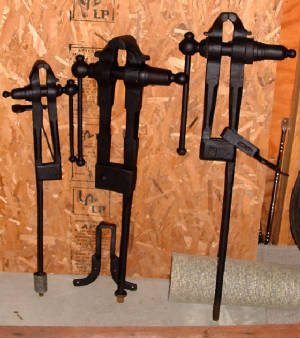
Best of all what's called a POST vice, or a Leg vice... they are stupid expensive on ebay, but if you search around craigslist and auctions, or goto blacksmith gatherings, you can get them much more reasonably., they come in all sizes... bigger is better, but you can do alot on a small pne...
The Next set of tongs is a big more complicated, but you only need 2 things new.
I really like them, becasue you can make a set of jaw out of angle iron, and have a great set for holdtin round and square stock (you need one pair for each diameter of stock).
For this set you need a Welder (or access to a buddy who welds) and a way to cut metal...
Personally for a new guys starting on the cheap...i like 4" or 4.5" grinder at Harbor Freight, plus a pack of assorted disks
(including cutting disks) can be had on sale for around $25. that's a
hard price to beat. The 4" grinders used to be the cheapest, but lately
it's the 4.5" ones.. just pick one size and stick with it... I have 3 of the same size,
one with a grinding disk, one with a sanding flap wheel and one with a
cutting disk so I don't have to change them out while working.
But you can totally so this with a Hand Hacksaw, and a Drill (plus access to a welder)
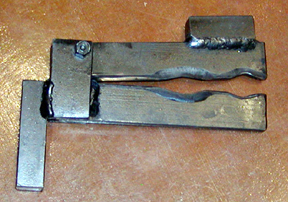
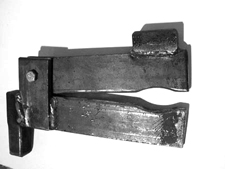
Next, you need to cut two parallelograms out of bar stock, drill a hole in the center for the rivet.. this is the "joint" of your tongs.(See pic below)
Next weld on reigns( handles) on onside, at the corner sticking out,
and Jaws (the part that holds the metal). on the opposite site. You make the two identical... when you flip and rivet everything works out even though it feels weird to make 2 of the same thing the first time....... (See pic below)
Remember you make two identical, the rotation and flip handles the symmetry.
The jaws can be made any shape you want flat, pipe, angle iron... super easy if you have a welder
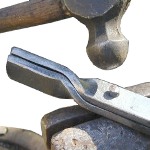
If you make the flat jaws in the diagram below, it's super easy to heat them up, put the new flat stock you want in the jaws and hammer it till it fits tightly...they look odd all bent together then flat, but they work ok.. the heavier the stuff you want to forge, the heavier the tongs you need.Make a couple light ones (1/8 stock for joint & jaws) to get you started. then make what you need, start practicing the forged ones too.. but this gets you started.
Ignore all the text below, it didn't' scale, it's basically what i said here.
Here are several style the guy on ebay used to make...to hold different stock...
Including V-bit (though I just welded my angle iron directly to the parallelogram)
Once you've made the ez twist tongs in my previous post, try these...
Make a set of jaws as before using the twist method previously mentioned or by forging them...., and weld on some more comfortable round reigns (handles)
Another twist is to cut pieces off flat barstock, and weld on whatever jaws you want, and rivet them up.
Fullering is the spreading of metal, and it's used in a lot of projects...
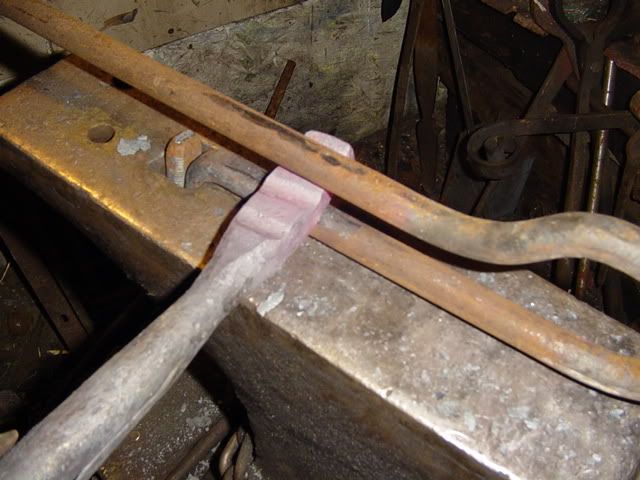
Another option other than the guillotine fuller is the spring fuller... Very simple and robust.
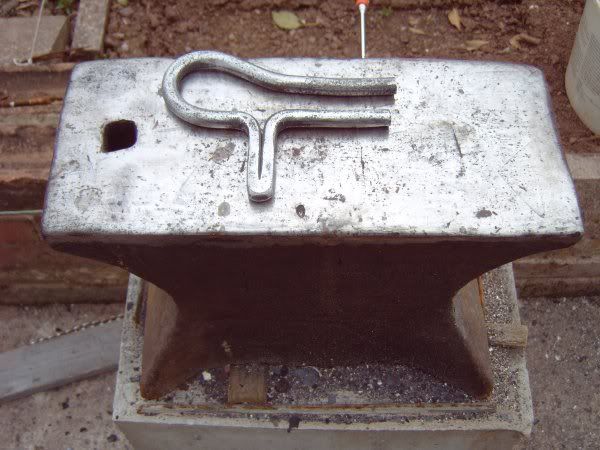
Make a bend one side of the middle o0f a rod, so it will fit in the hardy (the sqauare hole) in your anvil. If you don't have an anvil, put it in your vice... if you don't have a vice... get one cheap from some place like harbor freight.
You can also weld on the hardy shank (the part that goes in the square hole)
You can also use it to put "fullers" in to metal, for grip, decoration, or to make a piece lighter (like the fuller in a sword, or hammer).
Need one to fuller wider than round rod that will bend easily to do this? Weld up bigger jaws at teh fuller end
If you don't have round rod, you can weld it up using bar stick too
Again, the better the jaws lien up, the better it works. So you can add bits to help it line up
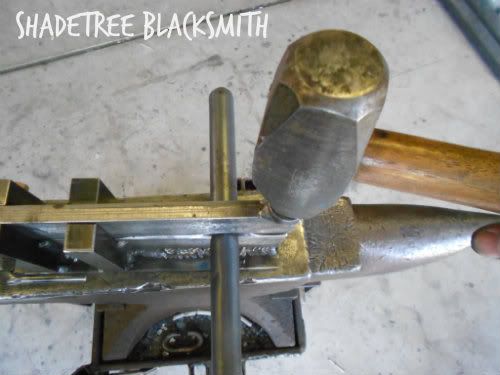
The basic idea here is to make something that fits into the hardy(the square hole in the anvil) to help you spread out metal. You can also do alot of other things on it.. Be aware these designs require a welder and a way to cut metal...
If you Google there are tons of way to skin this challenge..
My hint is to make it robust.. the stronger it is the better the jaws line up (see the extra pieces in the top on to forget eh jaws to line up, because hi joint is flimsy).
The better the jaws line up, they happier you will be with your fuller.
Also notice the curved part ground out.. this is to help hold your metal so it doesn't' squirt out when you are reducing the middle of bar on it...
You can also add a handle to make it easier to open while holding hot metal
Here are a few more pics to get your mental juices flowing...
I don't have all of these, just one like the very top.. but i want them :)
Before you can start blacksmith you have to answer one simple question,
what's your heat source....
I'm going to assume you've gotten this figured out...
something to hit on, and something simple to hit with, again, I assume you've got this figured out.
I'm hoping to go uber primitive on this equipment to see what i can do, but for now let's get that most useful, and yet scary for the new smith to tackle...(at least i was for me)
Tongs:
Lots of great patterns, but most of them expect you to spend forever hammering out the reigns...for a first time smith this can be boring (at least it was for me, good practice, but boring..) combined with the perceived complexity... tongs got bought...
But you can make a couple perfectly good tongs your self, simply, even if you barely know how to blacksmith at all... best of all you don't need tongs to make them!
If you use a nail for a rivet, soak it in vinger a day ro so to eat of the zinc.. zinc smoke is BAD for you... BAD!
Go read that tutorial now, and then come back and read the rest of this...heck, even go make a pair following their instructions and then come back...
The
nice thing here is if you make the jaws part longer on a couple pairs
you can easily fit them to hold any stock, like in seconds... heat them
up, grab a piece of what you want, and a few taps of a hammer later the
jaws are custom fit... If you've never done much blacksmithing.. Start
with a pair of these...
They look terrible hanging on a tong stand,because the reigns are solid bars, but other than that work ok.
The Tongs...
Get some flat bar stock, around 1/8 thick, by around 3/4" wide (a little bigger is good smaller is bad)
Measure back to where you want the joint (hinge) drill a hole and pop in a rivet... peen it down, and
then put in a vice and twist...
This is a different order than the tutorial above, but I find it easier... cut to length, drill, put jaws in vice with rivet just far enough above jaws of vice to get crescent wrench in there... slide on between the the vise and rivet and twist 90 degrees...
Easy as pie.
Here is an image that is really worth more than all the words above..
They are also called "ez tongs" or BSA tongs...
Here is a video of a guy making them on Youtbe using a bolt to make the rivets...
You can also make other shaped tongs, like bolt tongs.. not GOOD tongs, but better than no tongs...
Or hold other kinds of stock by shaping the jaws.
The easiest way to reshape the jaws is to start before they are riveted together and get them in a vague approximation of the shape you want,and after assembly is to get the jaws (the grabbing part) red hot, grab a piece of the metal you want to hold and then hit the jaws with a hammer on the anvil till they fit on the metal perfectly.